
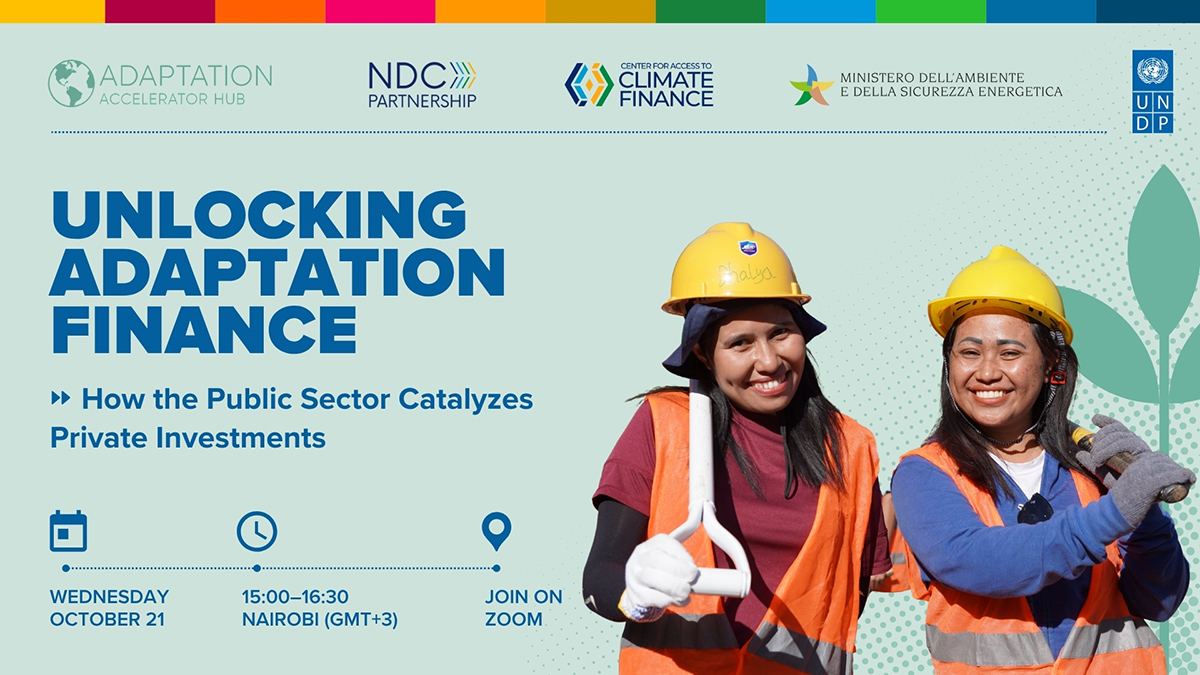
Date: Wednesday 21 October 2026
Time: 8:00–9:30 EDT (New York) | 14:00–15:30 CEST (Europe) | 15:00-16:30 GMT+3 (Nairobi) | 19:00-20:30 ICT (Bangkok)
As the gap between adaptation needs and available funding widens, the private sector is becoming increasingly important to adaptation finance and investment. Co-organized by the Adaptation Accelerator Hub (AAH), NDC Partnership and Center for Access to Climate Finance, the 2026 AAH Webinar Series examines how public-private collaboration can connect national adaptation priorities with private investment.
The third webinar will explore how governments can catalyze private investment through the right policies, regulations, climate data and financial instruments. It follows webinars on adaptation as a strategic business opportunity and innovative financing solutions.
The challenge: The growing adaptation financing gap
As climate impacts intensify, Least Developed Countries and Small Island Developing States face the most severe consequences. Heatwaves, flash floods, rising sea levels, hurricanes and droughts are taking a growing human and economic toll, damaging infrastructure, disrupting supply chains and threatening food security.
According to UNEP’s Adaptation Gap Report 2025, developing countries will require US$310 billion to US$365 billion annually by 2035 to build climate resilience. International public adaptation finance stood at just US$26 billion in 2023 – leaving needs 12 to 14 times greater than public flows.
Although the private sector drives more than half of global climate mitigation finance, it contributes only 1–2 percent of adaptation spending. Market barriers and high risks can make adaptation projects appear unprofitable. Gaps in regulations, climate data, standardized risk metrics, fiscal incentives and well-targeted public finance create a double bottleneck: investors cannot accurately assess risks, while countries struggle to turn their NAPs and NDCs into pipelines capable of mobilizing private capital.
The solution: The public sector as a catalyst for private capital
National governments, state-affiliated institutions, multilateral climate funds and multilateral development banks play a critical role in unlocking private capital. Many adaptation measures are public goods and will continue to require public or concessional finance. However, strategic public resources can create an enabling environment that makes revenue-generating, cost-saving and risk-reducing activities financially viable.
Governments can establish stable legal, fiscal and regulatory frameworks, including clear cost-recovery rules, tax incentives and standardized corporate climate-risk disclosures. The public sector can also fund open-access climate data, advanced weather forecasting and early warning systems.
Where policy and data are not enough, guarantees, concessional debt, first-loss facilities, blended finance and insurance can improve risk-return profiles. Scaling private investment depends on matching and sequencing the right tools with the right partners and risks.
Webinar objectives
Identify and analyze the barriers that limit private sector investment in adaptation.
Showcase the catalytic role of public finance by highlighting how public de-risking instruments (like guarantees and blended finance) can absorb risk and crowd in private capital.
Demonstrate how to match the right financial tools with specific actors, risk profiles, and adaptation needs.
Explore practical ways to accelerate pipelines by translate national priorities (NAPs/NDCs) into structured, bankable project pipelines.
Emphasize the need for strengthening enabling environments through public finance, policy, regulations, and climate data to make private investment viable.