
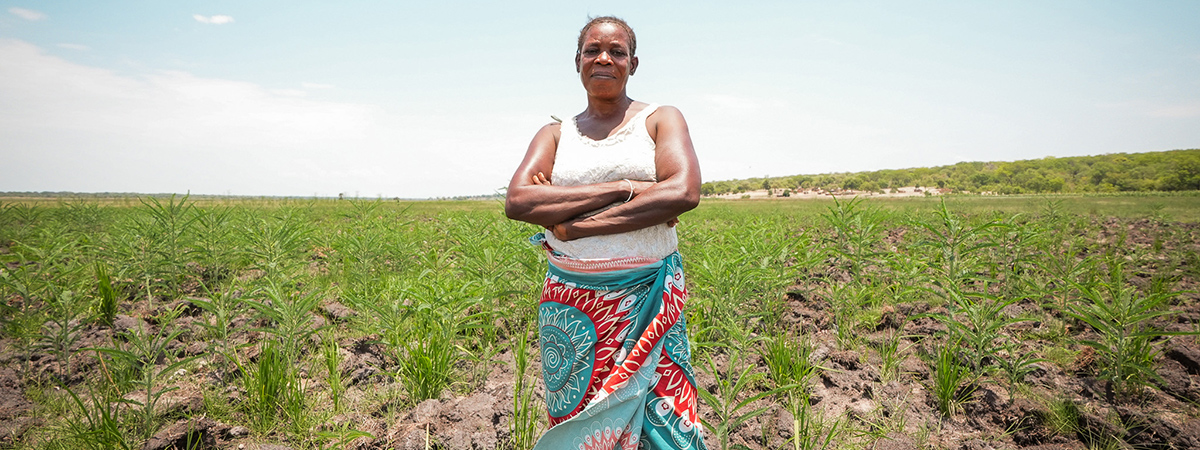
Photo:
Southern Africa is experiencing severe impacts of climate change, with widespread water scarcity and land degradation having profound implications for food security, poverty and sustainable development. Smallholder farmers and herders are particularly vulnerable, facing increasing exposure to climate-driven droughts, floods and erratic rainfall patterns that threaten their livelihoods.
The Financing Locally Led Adaptation and Nature-based Solutions for Catchment Resilience programme (2027 – 2032) directly addresses these challenges in Eswatini, Zambia and Zimbabwe. The project will finance the design and implementation of Catchment Investment Programmes (CIPs) – initiatives that are planned, developed, implemented and coordinated by local communities themselves.
Through its locally-led approach, the programme supports nature-based solutions (NbS) such as watershed management, forest and wetland restoration, and sustainable rangeland management. To ensure long-term sustainability, the project will also establish innovative financing mechanisms, such as blended finance for climate-resilient agriculture (CRA) and Payment for Ecosystem Services (PES) schemes, to create lasting pathways for investment.
By empowering local communities with direct access to finance and decision-making power, the project aims to build lasting socio-ecological resilience to the escalating impacts of climate change.
- Community
- District
- National
- Regional
- Local Governments
- National Governments
- Non-Governmental Organizations
- Private Sector Partners
- United Nations Development Programme (UNDP)
- Adaptation Fund
- Government of Zambia
- Ministry of Environment and Natural Resources Management, Zimbabwe
Expected outcomes
Outcome 1: Catchment Investment Programmes (CIPs), consisting of multiple complementary resilience-enhancing initiatives, prepared by local communities and organizations and relevant stakeholders
Outcome 2: Locally led adaptation initiatives financed and implemented to meet CIP objectives for enhanced socio-ecological resilience to climate change, with complementary non-grant mechanisms established to sustain and scale results
Outcome 3: Evidence generated from CIPs and their catchment management initiatives is used to strengthen climate adaptation policies and strategies, and to improve adaptive management and stakeholder learning across catchment
- Image

- Image

- Image

- Image
- Image

- Image

- Image

The programme was developed in response to the complex and escalating climate risks facing Southern Africa. Stakeholders across Eswatini, Zambia, and Zimbabwe consistently emphasized that plot-level climate-resilient agriculture alone is not durable in landscapes where catchments are already degraded and water reliability is declining. This led to the design of an integrated programme that couples nature-based catchment restoration and improved water governance with market-linked finance for climate-resilient agriculture (CRA) and locally-led adaptation support.
The programme’s theory of change is rooted in the principle that access to and productive management of water and land is most effectively tackled ecologically at the level of hydrological systems, or catchments. The approach posits that upstream restoration and other landscape-level Nature-based Solutions (NbS)—such as forest and wetland restoration, sustainable rangeland management, and protection of riverine vegetation—improve the biophysical conditions under which farms operate. This leads to more reliable soil moisture and streamflow, reduced erosion, and moderated floods and droughts.
Building on this foundation, the adoption of farm-level CRA practices—such as efficient irrigation, soil-moisture conservation, and stress-tolerant crop varieties—helps to stabilize and increase yields and cash flows. This, in turn, lowers borrower risk and improves credit eligibility. This linkage creates the opportunity to work with financial institutions to extend "green credit" to farmers and establish other sustainable financing mechanisms, like Payment for Ecosystem Services (PES).
This holistic response is implemented through Catchment Investment Programmes (CIPs), which empower local communities with the agency and financial resources to define, prioritize, design, and implement their own climate actions. This ensures that adaptation is not only effective but also equitable and sustainable over the long term.

Outcome 1: Catchment Investment Programmes, consisting of multiple complementary resilience-enhancing initiatives, prepared by local communities and organizations and relevant stakeholders.
Output 1.1: Multi-stakeholder National Catchment Adaptation Committees established (NCACs)
Output 1.2: Multi-stakeholder catchment management and governance platforms in the target catchments established
Output 1.3: Catchment Investment Programme confirmed in each participating country
Output 1.4: Priority community and catchment level initiatives in the CIPs identified and designed
Outcome 2: LLA initiatives financed and implemented to meet CIP objectives for enhanced socio-ecological resilience to climate change, with complementary non-grant mechanisms established to sustain and scale results
Output 2.1: Locally-Led Adaptation initiatives designed and implemented, according to CIP objectives
Output 2.2 Capacities of local organizations strengthened for grant project design, implementation and MRV and broader NbS interventions implemented for CIP objectives.
Output 2.3 Establishment of non-grant financing mechanisms for sustained implementation of LLA initiatives
Outcome 3: Evidence generated from CIPs and their catchment management initiatives is used to strengthen climate adaptation policies and strategies, and to improve adaptive management and stakeholder learning across catchments
Output 3.1: Development and implementation of a peer-to-peer learning and exchange Programme at national and local levels for upscaling and adaptive management
Output 3.2: Establishment of a regional mechanism for analysis and discussions of lessons learned, their relevance and potential application to policy, programming, and partnership development
Output 3.3: Development of a regionwide Adaptation Learning Programme from catchment planning and implementation experience for national, regional and global engagement
Monitoring of community and initiative level activities is embedded in implementation of the project and will be carried out through a participatory, multi-tiered system. At initiative level, community groups and local implementing partners will track progress against agreed milestones using simple, participatory monitoring tools, supported by training under Output 2.2. Designated community or initiative focal points will consolidate this information and submit periodic updates to the National Coordinator.
The National Coordinator will undertake regular field visits, in some cases jointly with NCAC members, to verify reported progress, support problem-solving, and validate results with communities. In parallel, catchment multi- stakeholder platforms will designate monitoring focal points to review initiative-level progress across the catchment and facilitate collective reflection during platform meetings.
Verified initiative-level data will be entered into the CIP-level MRV system and aggregated at catchment level, forming a core input to the programme M&E system. This information will be used for performance tracking, adaptive management, learning products, and reporting, and periodically reviewed by NCACs to inform strategic adjustments and policy-relevant insights
The regional programme as well as the individual CIPs will be monitored and evaluated under distinct budgets and protocols, in line with the Adaptation Fund Evaluation Policy. The M&E plan will ensure the management of environmental and social risks at regional programme and national/catchment levels.
Programme-level monitoring and evaluation will be undertaken in compliance with the UNDP policies and procedures, UNDP Evaluation Policy and with the Adaptation Fund Evaluation Policy and Environmental and Social Policy.
Radhika Dave, Principal Technical Advisor, Climate Change Adaptation, UNDP, radhika.dave@undp.org
Shovon Kibria, Private Sector Engagement Specialist & Regional Technical Advisor, UNDP shovon.kibria@undp.org