
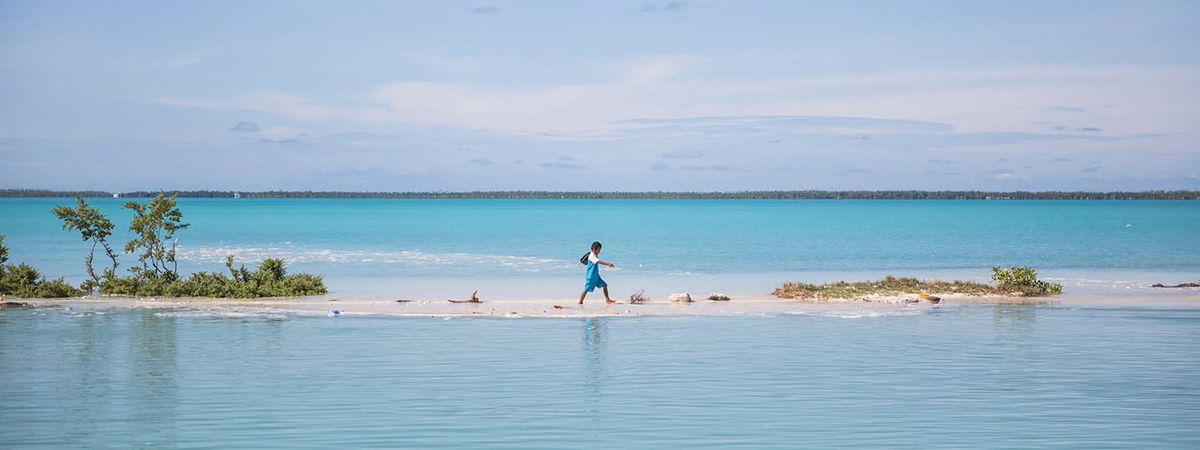
Photo:
Communities across the Federated States of Micronesia (FSM) face growing risks from extreme weather events, flooding, drought and sea-level rise. While the government has established disaster management systems, emergency communications and state-level preparedness mechanisms, gaps remain in ensuring that warnings reach remote and vulnerable communities quickly, reliably and inclusively. Existing communication systems require improved reliability, maintenance and backup power, while emergency procedures, reporting systems and community preparedness need further strengthening to ensure people can act on warnings and access timely assistance.
The proposed project Strengthening Climate-Informed Early Warning and Community Resilience Systems in the Federated States of Micronesia will strengthen the operational readiness of existing early warning systems, last-mile communications and early-action capacity in Kosrae State, seven outer islands of Pohnpei, and priority warning locations in Yap and Chuuk.
The project will strengthen coordination, standard operating procedures, communication testing, maintenance arrangements and training for national, state and community responders. It will also address critical communication gaps by strengthening emergency broadcast systems, HF radio communications, public warning sirens, backup power and other essential equipment to improve the reliability and continuity of warning services.
At the community level, the project will develop warning-to-action guidance, strengthen emergency reporting and conduct training and simulation exercises with municipal focal points, schools, churches, women's and youth groups, organisations representing persons with disabilities, and other local stakeholders. Together, these measures will help vulnerable communities receive timely warnings, take early action and better prepare for climate-related hazards.
- Community
- Municipality
- National
- Local Governments
- National Governments
- Non-Governmental Organizations
- Private Sector Partners
- United Nations Development Programme (UNDP)
7,000 direct beneficiaries (~50% women)
- FSM Government
Expected outcomes
Component 1: Strengthening Early Warning Readiness, Coordination, and Operating Procedures
Component 2: Improving Last-Mile Warning Communication and System Reliability
Component 3: Strengthening Inclusive Early Action and Community Reporting
- Image
- Image
- Image
- Image
- Image
The Federated States of Micronesia (FSM) is one of the world's most geographically dispersed Small Island Developing States, comprising more than 600 islands spread across almost 3 million km² of ocean. This geography presents unique challenges for disaster preparedness and emergency response, as national and state institutions must provide timely warnings and coordinate emergency action across remote islands and isolated communities with limited transport and communications infrastructure. Climate change is increasing these challenges, with communities in Kosrae State, seven outer islands of Pohnpei, and selected high-risk communities in Yap and Chuuk facing growing risks from extreme weather events, flooding, drought, sea-level rise, coastal inundation and saltwater intrusion.
FSM has already made significant investments in disaster preparedness and emergency communications, including expanding HF/VHF radio networks and emergency operations infrastructure. However, assessments have found that the remaining challenge is not the absence of early warning systems, but ensuring they function reliably during emergencies. Gaps remain in last-mile communications, maintenance, backup power, routine testing, emergency reporting procedures and the ability of communities to receive, understand and act on warnings, particularly in remote outer-island communities and among vulnerable groups.
Building on existing disaster management systems and previous investments in emergency communications, the project adopts an end-to-end approach to strengthening the operational readiness, reliability and inclusiveness of early warning systems. It focuses on the remaining "last-mile" gaps that prevent warnings from reaching vulnerable communities, ensuring climate and hazard information is translated into timely warnings, effective emergency reporting and early action from national and state institutions through to municipalities, outer-island communities and vulnerable households.
The project is structured around three complementary components. The first will strengthen early warning readiness by improving coordination, standard operating procedures, emergency reporting, routine testing, maintenance and the capacity of national, state and community responders. The second will strengthen existing emergency broadcast systems, HF radio communications, public warning sirens, backup power and other priority communications equipment to improve the reliability and continuity of warning services. The third will strengthen inclusive early action by developing warning-to-action guidance, improving emergency reporting and conducting training and simulation exercises with municipal focal points, schools, churches, women's and youth groups, organisations representing persons with disabilities and other local stakeholders.
Activities will primarily focus on Kosrae State and seven outer islands of Pohnpei, with targeted support for priority public warning systems in Yap and Chuuk where these address verified last-mile communication gaps. Throughout implementation, the project will apply participatory, gender-responsive monitoring and evaluation to measure project effectiveness, capture lessons learned and support adaptive management.
The overall objective of this project is to strengthen climate-informed early warning, last-mile communication reliability, and inclusive early-action readiness for vulnerable communities in the Federated States of Micronesia.

Component 1. Strengthening Early Warning Readiness, Coordination, and Operating Procedures
Output 1.1. Existing early warning, communication, EOC, and community preparedness assets in Kosrae State and selected Pohnpei outer islands assessed, mapped, and screened for remaining gaps;
Output 1.2. Early warning coordination, communication testing, emergency reporting, and inclusive warning procedures updated, tested, and operationalized by DECEM, Kosrae State, Pohnpei State, and target communities
Component 2. Improving Last-Mile Warning Communication and System Reliability
Output 2.1. Kosrae and Pohnpei AM emergency broadcast systems strengthened with priority reliability measures;
Output 2.2. Pohnpei State EOC HF radio communication restored and compatible HF communication systems established/ upgraded for seven outer islands enabling warning dissemination and emergency reporting;
Output 2.3. Necessary backup power, spare parts, and testing tools are procured, and regular radio checks and repair procedures are established for priority early warning communication assets in Kosrae State and seven Pohnpei outer islands;
Output 2.4. Priority public warning siren systems in Yap and Chuuk State installed, tested, and integrated into state warning procedures.
Component 3. Strengthening Inclusive Early Action and Community Reporting
Output 3.1. Warning-to-action messages, emergency reporting tools, and community emergency guides developed, tested, and operationalized for target communities in Kosrae State and selected Pohnpei outer islands;
Output 3.2. Municipal and outer-island focal points, community groups, schools, churches, women’s groups, youth, persons with disabilities, and local response actors trained to disseminate warnings, support vulnerable households, and report local conditions, impacts, and needs
Karma Rapten, Regional Technical Advisor, Climate Change Adaptation, UNDP karma.rapten@undp.org