
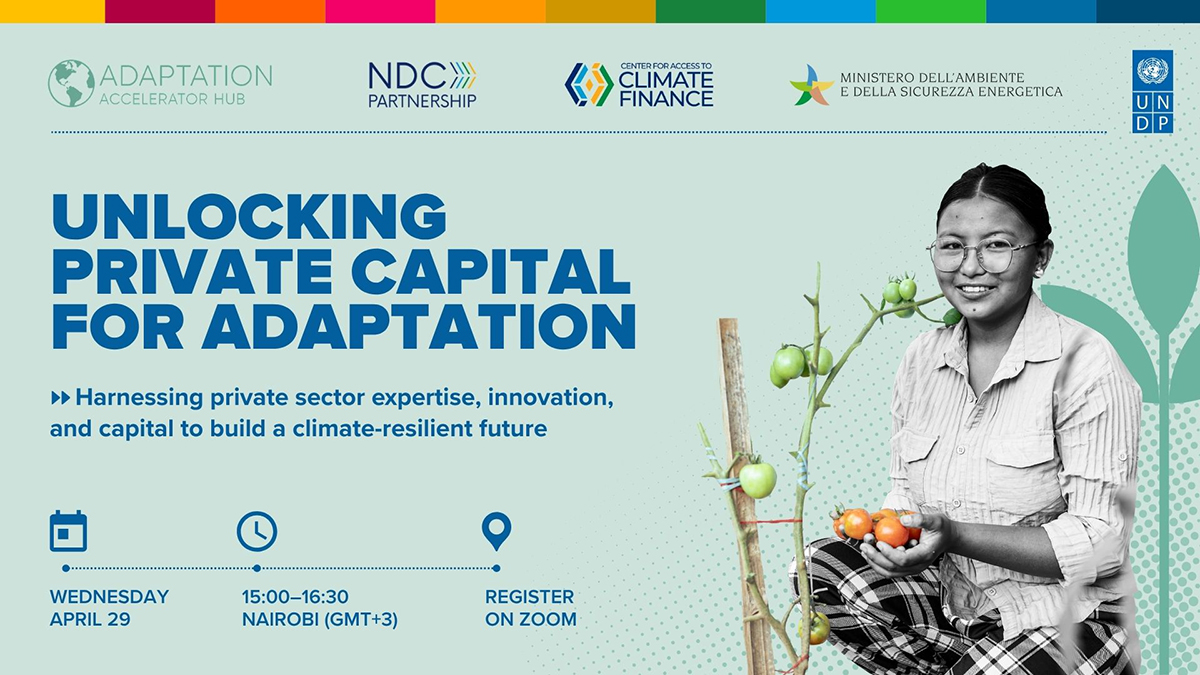
Date: Wednesday 29 April
Time: 8:00–9:30 EDT (New York) | 14:00–15:30 CEST (Europe) | 15:00-16:30 GMT+3 (Nairobi) | 19:00-20:30 ITC (Bangkok)
As the gap between adaptation needs and available funding widens, the private sector is becoming increasingly important in adaptation finance and investments. The 2026 Adaptation Accelerator Hub (AAH) webinar series focuses on private sector engagement. By highlighting technical support provided by the AAH, the series will demonstrate how collaboration between policymakers, financiers, and enterprises can bridge the divide between national adaptation priorities and private investment.
This webinar, Unlocking Private Capital for Adaptation, highlighted adaptation as a strategic, profitable business opportunity and the role of the private sector from peripheral financiers to core drivers of resilience. It also looked at how the AAH helps translate national priorities (NDCs/NAPs) into bankable, and implementation-ready investment plans by using country examples.
The challenge: Closing the adaptation finance gap
The global climate crisis has created an urgent financing gap. Developing countries face annual adaptation needs of up to $365 billion by 2035, yet international public finance was approximately only $26 billion in 2023. While the private sector already drives over half of global climate mitigation (emissions reduction) finance, it currently contributes just 1–2 percent of adaptation spending. This disparity puts lives, livelihoods, and entire economies at risk. However, approximately one-third of adaptation finance needs, as identified in NAPs and NDCs, are in areas with clear potential for private investment, demonstrating the need and opportunity for private sector engagement in adaptation finance.
The solution: The private sector as a core driver
The solution to the adaptation gap lies in moving the private sector from a peripheral financier to a core driver of climate resilience. Approximately one-third of national adaptation priorities have clear potential for private investment. When engaged holistically, private actors serve as innovators, logistics experts, and technical specialists capable of delivering climate-resilient products and services at a scale and pace the public sector cannot achieve alone. By aligning adaptation with profitability, businesses can protect asset values, secure supply chains, and unlock new markets.
The G7 Adaptation Accelerator Hub (AAH) acts as a critical enabler within the finance ecosystem. The AAH provides the operational backbone needed to translate national climate priorities (outlined in Nationally Determined Contributions and National Adaptation Plans) into bankable, implementation-ready investment plans. By facilitating policy alignment, providing technical project preparation, and designing risk-sharing structures, the AAH removes the structural barriers that currently sideline private capital.
Webinar objectives
The session positioned climate resilience as an untapped $300 billion market, emphasizing how adaptation investments foster sustainable growth and enhance cooperation within the financial sector to mobilize capital for vulnerable regions. The webinar:
- Examined the market inefficiencies hindering investment and identify targeted policy reforms and risk mitigation instruments.
- Highlighted the multifaceted role of businesses in adaptation, recognizing their contributions as innovators, logistics providers, and technical experts beyond traditional financing.
- Illustrated the opportunities for private sector involvement in adaptation through case studies of successful privately led initiatives.
- Presented developments in countries such as Ethiopia, Maldives, and Cambodia to demonstrate how AAH support strengthens national readiness and facilitates the transition from climate planning to actionable, investment-ready solutions.