

UNDP has released the Impact Report of the Adaptation Fund Climate Innovation Accelerator (AFCIA), highlighting five years of locally led innovation and community-driven solutions that are transforming climate resilience across the Global South.
Supported by the Adaptation Fund and the European Union, UNDP-AFCIA invested US$8.3 million in 44 grassroots initiatives in 33 countries, complemented by over $6 million in technical assistance. The results are striking: more than 2.6 million people reached, 29,000 hectares of land restored or protected and over $3.86 million in follow-on funding unlocked by community organizations.
“Locally led action is one of the most powerful ways to build climate resilience,” said Yusuke Taishi, UNDP’s Principal Technical Advisor for Climate Change Adaptation a.i. “This report shows that when communities have access to the finance, tools and partnerships they need, they turn even the smallest resources into lasting change.”
Innovation from the ground up
UNDP-AFCIA supported local organizations—Indigenous Peoples, women-led groups, youth innovators, community-based organizations and cooperatives—to test and accelerate new climate solutions. These ranged from floating farms in India to coral reef restoration in the Caribbean, aquaponics in Uganda, bamboo cultivation in the Philippines and digital tools that help small-scale fishers access safer seas and fairer markets in South Africa.
Fifty nine percent of grantees now generate revenue, enabling many of them to start shifting from grant-dependence to sustainable business models. Many pioneered new markets or built investment-ready models, demonstrating that adaptation innovation can strengthen both livelihoods and local economies.
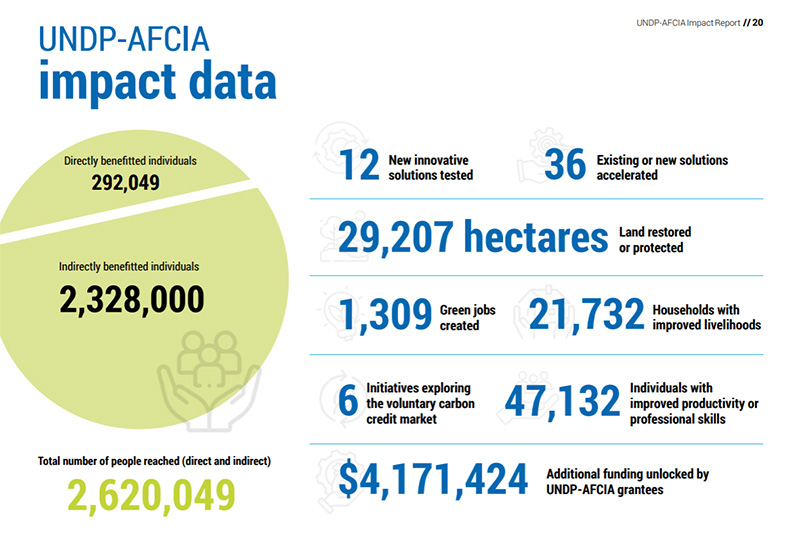
Image: The impact of the UNDP-AFCIA programme in numbers
Communities at the heart of resilience
The report elevates stories from farmers, fishers, Indigenous leaders and entrepreneurs who are designing their own adaptation pathways. Maasai seed collectors in Tanzania, youth-led water entrepreneurs in Bangladesh and communities from Small Island Developing States like Fiji and Vanuatu describe how new tools and revived traditions are helping them navigate worsening droughts, floods and storms.
Their experiences underscore a central lesson: solutions anchored in local knowledge—supported rather than replaced by technology—deliver stronger, more sustainable outcomes.
A growing ecosystem for adaptation innovation
Beyond grants, UNDP-AFCIA invested in the systems that help local actors scale. Partnerships with the Global Resilience Partnership and global business schools from the Global Network of Advanced Management connected initiatives with MBA students to refine business plans, strengthen financial models and explore blended finance pathways. Collaborations with networks such as AVPN, AVPA, Latimpacto and national partners expanded access to impact investors and philanthropies across regions.
These efforts helped bridge the “missing middle”—the gap in financing for community initiatives that are too large for microfinance but too small for commercial lenders. The report highlights emerging lessons for donors and investors seeking to create more inclusive, patient finance for adaptation at scale.
Looking forward
The UNDP-AFCIA Impact Report offers a roadmap for accelerating climate adaptation where it matters most: in the hands of communities on the frontlines. As climate risks intensify, the insights and models shared in this report can guide governments, funds and development partners working to strengthen locally led adaptation ecosystems.
The next phase of UNDP-AFCIA will build on these lessons, continue supporting early-stage innovators and deepen collaboration across sectors to unlock new forms of finance for adaptation.
“Communities are agents of change,” said Taishi. “Their leadership is essential for building resilient futures, and this report shows what becomes possible when we invest in their ideas.”
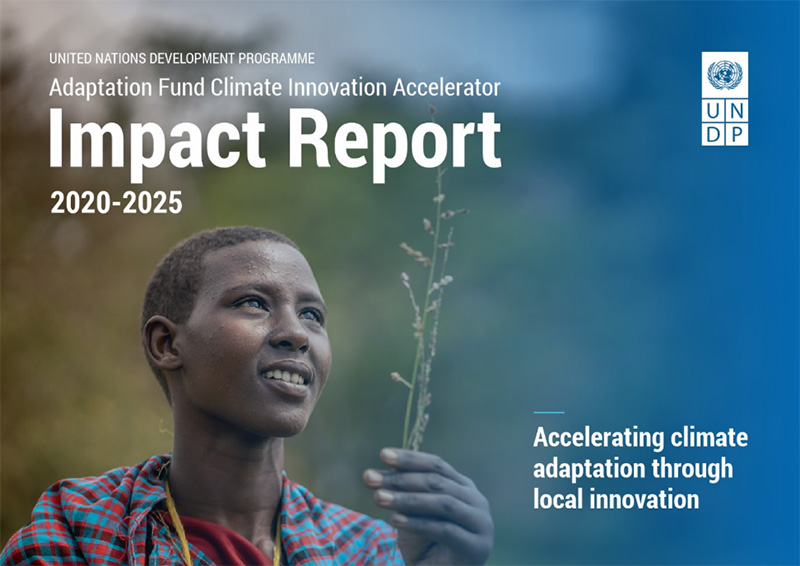
The full report is available for download here.
*
The UNDP-AFCIA Impact Report is complemented by the AFCIA Impact Report produced by the United Nations Environment Programme – Climate Technology Centre and Network (UNEP-CTCN), which highlights additional innovations, lessons and results emerging from the broader AFCIA Partnership. Taken together, these reports offer a full view of how AFCIA is accelerating climate adaptation through locally led solutions, knowledge exchange and catalytic support across the Global South.
Key findings from both reports were presented during global webinars on 3 February, with presentations and recordings available here.
EXPLORE MORE STORIES

The Global South have mastered locally led climate adaptation solutions. It's time to scale them up.
