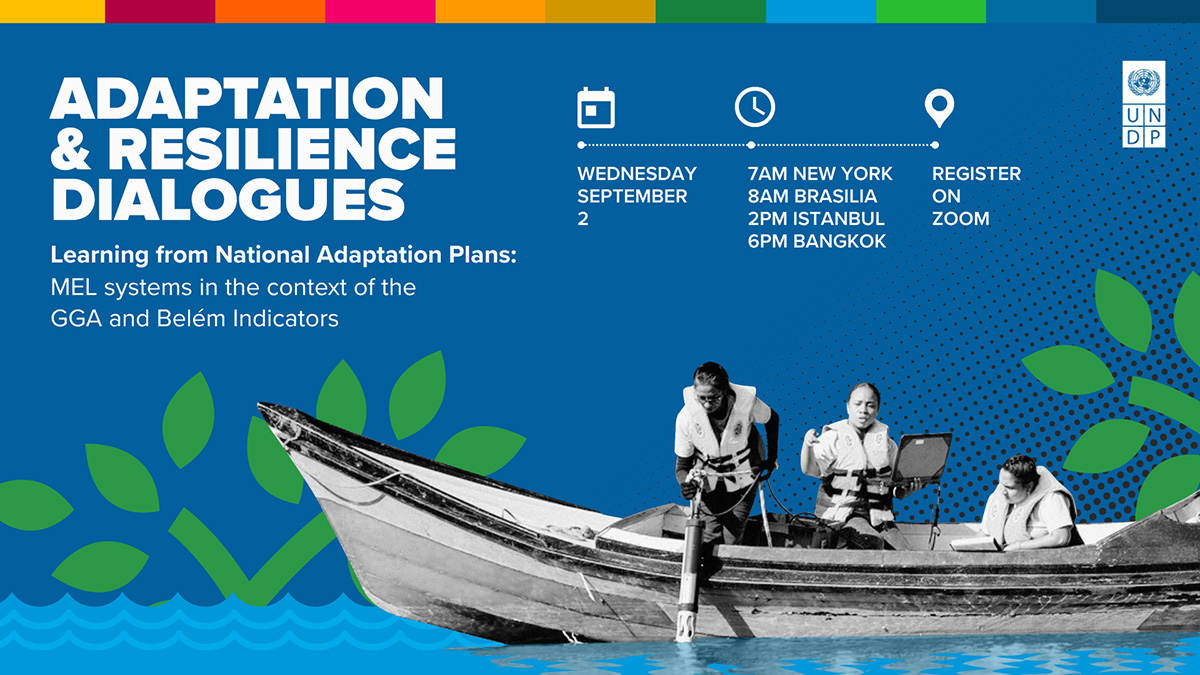
Virtual event | 90 minutes | September 2 | 7am New York | 8am Brasilia | 2pm Istanbul | 6pm Bangkok
Overview
Effective Monitoring, Evaluation and Learning (MEL) systems are fundamental to climate resilience and sustainable development. While directly aligning with Sustainable Development Goal (SDG) 13 on climate action, robust MEL frameworks act as a critical enabler for several other global goals, including ending poverty (SDG 1), reaching zero hunger (SDG 2), supporting clean water and sanitation (SDG 6) and protecting life on land (SDG 15).
To track global adaptation progress, the international community established the Global Goal on Adaptation (GGA). More recently, the UAE Framework for Global Climate Resilience set an urgent mandate: by 2030, all Parties must have designed, established and operationalized a MEL system for their national adaptation efforts.
The United Nations Development Programme (UNDP) supports this global effort by helping countries build institutional capacity to transition from planning to measurable action. In collaboration with the UNDP-FAO SCALA programme, this dialogue will explore the critical steps required to build these frameworks, inviting government representatives, development partners, academia and civil society to reflect on emerging practices, share lessons learned from UNDP’s global National Adaptation Plan (NAP) portfolio and build the technical capacity needed to track adaptation effectively.
Why this event matters
As climate impacts intensify, the need to scale and operationalize national adaptation tracking has never been more urgent. Despite significant progress in formulating planning instruments—with 172 countries having formulated adaptation plans or other policies and strategies—many nations, particularly Least Developed Countries (LDCs) and Small Island Developing States (SIDS), still face key barriers in establishing and sustaining effective MEL systems.
At the national level, MEL frameworks are more than administrative requirements, they are essential instruments to leverage funding and accelerate the implementation of adaptation projects. Visible evidence of progress builds investor confidence and fosters resource allocations towards national adaptation priorities.
By highlighting key lessons learned from UNDP’s NAP portfolio and practical country experiences, this dialogue provides actionable pathways to bridge the gap between global targets, like the Belém indicators, and local adaptation action.
Date
Wednesday 2 September 2026
Time
7am New York | 8am Brasilia | 2pm Istanbul | 6pm Bangkok
Moderator
Prakash Bista, Climate Change Adaptation Specialist, UNDP
Link to recording
Agenda
| 10 mins | Opening remarks: Setting the scene on the UAE Framework, Belém Indicators and MEL systems. | Rohini Kohli, Head of Adaptation and Resilient Societies, United Nations Development Programme (UNDP) |
| 10 mins | Insights from the field: Lessons learned from UNDP’s National Adaptation Plans’ portfolio. | Patricia Velasco, Climate Change Adaptation Specialist, United Nations Development Programme (UNDP) |
| 45 mins | Panel discussion: Operationalizing national MEL systems. Experiences from Thailand, Kyrgyz Republic, Egypt, Tanzania and Panama. | Mr. Teerapat Kamnuantip, Environmentalist at the Climate Change Adaptation Division, Department of Climate Change and Environment (DCCE), Thailand Ms. Zhamilya Dairova, Chief Specialist at the Environmental and Climate Policy Department, Ministry of Natural Resources, Ecology and Technical Supervision, Kyrgyz Republic Dr. Saber Osman, Assistant Minister of Environment and Local Development, and National Climate Change Focal Point to UNFCCC, Egypt Dr. Hamza Kija, Principal Research Officer at the Conservation Information and Monitoring Section, Tanzania Wildlife Research Institute (TAWIRI), Tanzania Ms. Katherine Martínez, Project Coordinator and Negotiator for Adaptation and Loss and Damage at the Climate Change Directorate, MiAmbiente, Panama |
| 20 mins | Q&A session | All participants |
| 5 mins | Closing remarks | Prakash Bista, Climate Change Adaptation Specialist, United Nations Development Programme (UNDP) |