

5 June 2026, Samarkand, Uzbekistan — Representatives from governments, multilateral climate funds, development organizations and national meteorological services gathered at the Eighth GEF Assembly today to explore how stronger partnerships and innovative financing can help close a critical weather and climate data gap that continues to undermine adaptation efforts in the world's most vulnerable countries.
Hosted by UNDP and UN Environment, the side event, "Complementarity and innovation to close the weather and climate data gap in LDCs and SIDS," focused on how improved climate observations can strengthen early warning systems, adaptation planning and climate resilience. The discussion brought together perspectives from the Systematic Observations Financing Facility (SOFF), World Meteorological Organization (WMO), the Adaptation Fund, Global Environment Facility, and the Fund for Responding to Loss and Damage (FRLD), alongside country experiences from Cambodia and Uzbekistan.
The discussion highlighted a stark reality: in Least Developed Countries (LDCs) and Small Island Developing States (SIDS), up to 90 percent of internationally compliant weather and climate observations are missing, limiting countries' ability to understand climate risks, plan effectively and protect communities from increasingly frequent and severe climate hazards.
Opening the event, Cassie Flynn, Director of UNDP's Planet Hub, emphasized that climate data is far more than a technical issue. "When we consider taking bold moves on adaptation, protecting lives and livelihoods, and ensuring that every dollar of climate finance has maximum impact, we need a strong foundation," Flynn said. "At UNDP, we do not see data as merely a technical issue; we see it as a development issue."
Flynn highlighted UNDP's role as one of the founding partners of SOFF and the largest implementer of early warning systems within the United Nations system, with programmes currently active in more than 40 countries. She underscored the importance of connecting investments in weather and climate observations with adaptation action on the ground.
Jessica Troni, Chief of UNEP's Climate Change Adaptation Unit, described weather and climate observations as "enabling infrastructure" for adaptation finance and stressed that closing observation gaps is a prerequisite for effective climate action. "We cannot forecast, warn, or plan for what we cannot observe," Troni said. "Closing the observation gap is not a technical sidebar; it is a prerequisite for effective climate finance." She emphasized the need for greater complementarity across climate finance mechanisms, noting that investments in observations, climate services, early warning systems and adaptation planning must function as a connected value chain rather than isolated projects.
Participants also highlighted the global benefits of strengthening weather and climate observations in vulnerable countries, noting that improved observations benefit forecasting systems worldwide.
Corentin Genin, National Focal Point for GEF and UNCCD at Belgium’s Ministry of Foreign Affairs, Foreign Trade and Development Cooperation, noted Belgium's role as a SOFF contributor and member of its Advisory Board, stressing that weather data is a global public good. "Closing the observation data gaps in one region improves weather forecasts everywhere – from vulnerable countries to Europe and beyond," Genin said. "Bridging the data gap is not a technical detail; it is a systemic enabler."
Jakhongir Islamov, Division Head of the Department for Digital Modelling and Regional Meteorological Systems at Uzbekistan Hydromet, described how regional cooperation and investments in modern meteorological infrastructure are strengthening forecasting capabilities and climate resilience across Central Asia. He emphasized the importance of reliable observations and cross-border data exchange in addressing shared climate risks, including droughts, dust storms and floods.
Navann Ouk, Deputy Director General of the General Directorate of Policy and Strategy at Cambodia's Ministry of Environment, highlighted how investments in climate observation systems are helping the government transform raw climate data into operational services that support decision-making in agriculture, water management, infrastructure planning and disaster risk reduction. He noted that climate information becomes most valuable when it informs practical adaptation decisions and helps unlock investment in resilience.
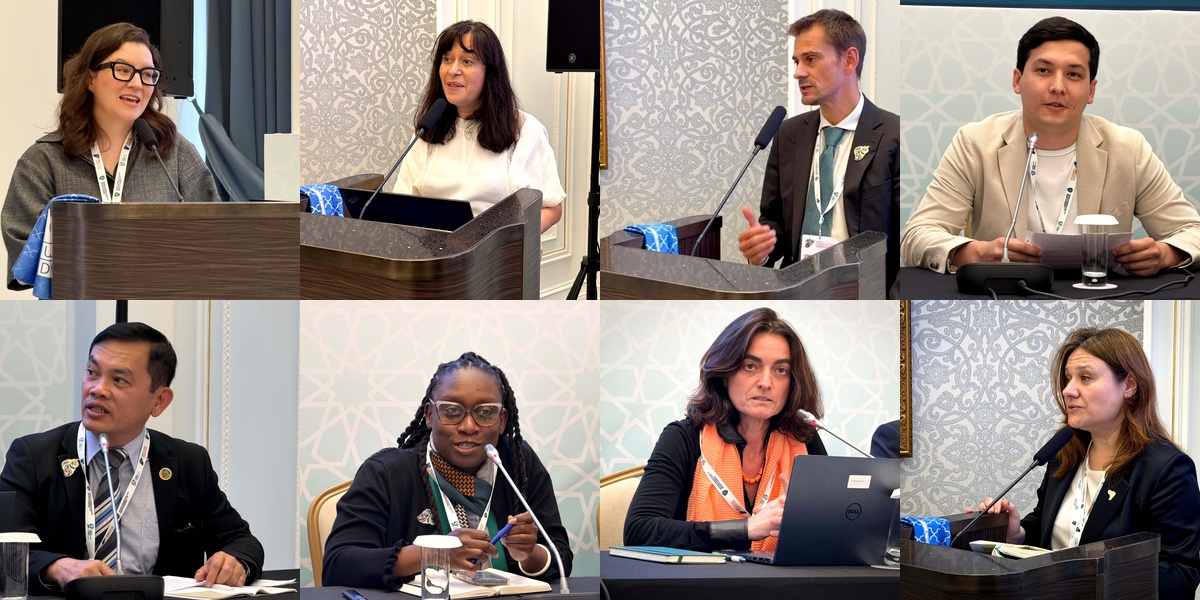
Top row (L-R): Cassie Flynn (UNDP), Jessica Troni (UNEP), Corentin Genin (Belgium’s Ministry of Foreign Affairs), and Jakhongir Islamov (Uzbekistan Hydromet). Bottom row (L-R): Navann Ouk (Cambodia's Ministry of Environment), Jacqueline Musiitwa (Fund for Responding to Loss and Damage), Silvia Mancini (Adaptation Fund), and Nataly Olofinskaya (UNDP).
A key focus of the event was the development of the proposed Systematic Observations Impact Bond, an innovative financing mechanism being developed by UNDP, UNEP and SOFF to help bridge a funding gap estimated at more than US$150 million by 2027. The mechanism would link repayments to independently verified improvements in internationally exchanged weather and climate observations, helping mobilize additional capital to support countries seeking to meet Global Basic Observing Network (GBON) standards.
Jacqueline Musiitwa, Program Manager for Board Affairs and Governance at the Fund for Responding to Loss and Damage, emphasized the growing demand from countries for stronger climate information systems, noting that data and risk information are emerging as a consistent priority in funding requests submitted to the newly operational fund. She said climate information systems are critical to helping countries better understand and address climate-related losses and damages and highlighted the importance of collaboration across climate funds and institutions to ensure countries can access the technical support and financing needed to strengthen resilience.
Silvia Mancini, Lead for Countries and Partnerships at the Adaptation Fund underscored ongoing efforts among multilateral climate funds to improve coordination and measurement of adaptation results, including the development of shared indicators and stronger alignment around early warning systems and climate risk reduction.
Throughout the event, speakers stressed that weather and climate observations are not an end in themselves. Rather, they provide the foundation for more accurate forecasts, stronger early warning systems, better-informed adaptation investments and more resilient communities.
The session concluded with a call for stronger collaboration among governments, development partners and climate funds to ensure that vulnerable countries are not left behind in the race for climate resilience.

EXPLORE MORE STORIES


