
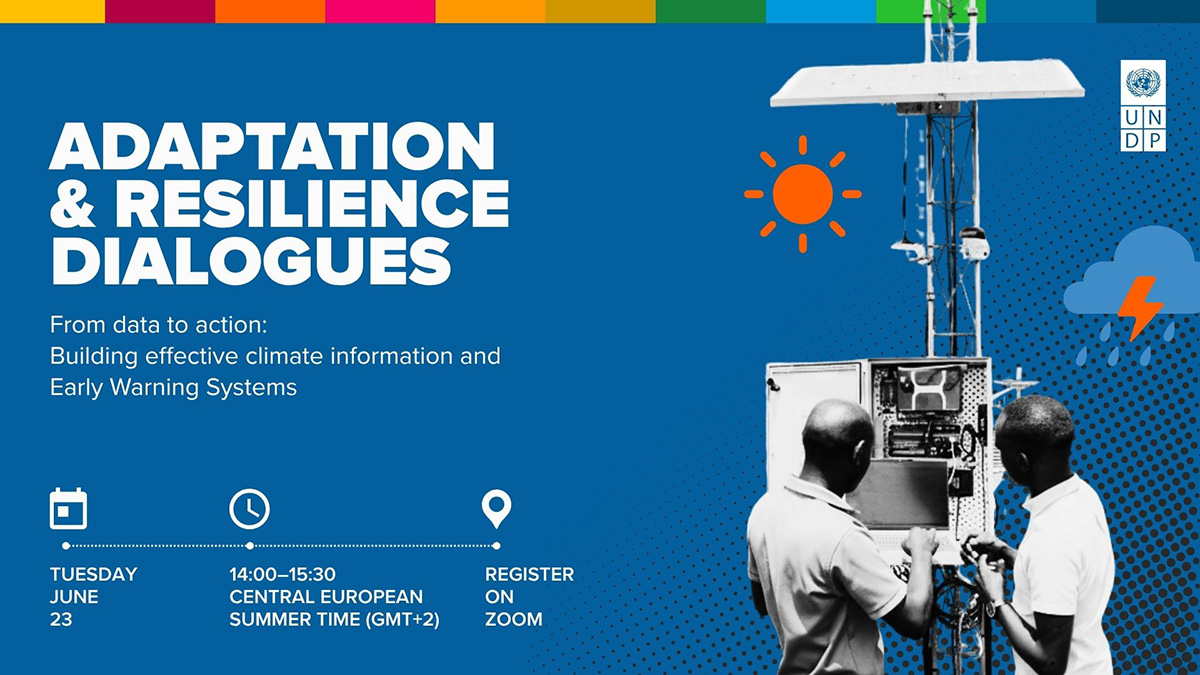
Virtual event | 90 minutes | June 23 | 14:00h (Central European Summer Time, GMT+2)
Overview
Effective climate information and Early Warning Systems (CIEWS) are fundamental for climate resilience and sustainable development. While directly aligning with Sustainable Development Goal (SDG) 13 on climate action, CIEWS act as a critical enabler for several other global goals, including ending poverty (SDG 1), reaching zero hunger (SDG 2), supporting good health (SDG 3), protecting clean water (SDG 6) and creating sustainable cities (SDG 11).
To address the escalating climate crisis, the UN Secretary-General launched the Early Warning for All (EW4All) initiative in November 2022, which aims to ensure that everyone on Earth is protected by early warning systems by 2027. The United Nations Development Programme (UNDP) supports this global effort in partnership with the Green Climate Fund (GCF), the World Meteorological Organization (WMO), the UN Office of Disaster Risk Reduction (UNDRR), the International Federation of Red Cross and Red Crescent Societies (IFRC) and the International Telecommunication Union (ITU).
This webinar explored the critical steps required to translate climate data into life-saving action. It invited government representatives, development partners, civil society organizations and private sector actors to reflect on emerging practices, share lessons learned from UNDP's global portfolio and build the partnerships needed to establish effective and sustainable multi-hazard early warning systems (MHEWS).
Why this event matters
As climate impacts intensify, the need to scale effective multi-hazard early warning systems has never been more urgent. Despite significant progress, many countries—particularly Least Developed Countries (LDCs) and Small Island Developing States (SIDS)—still face key barriers in establishing and maintaining these systems.
This event offered a space to share lessons learned and address the most critical hurdles, including:
- Last-mile connectivity: Ensuring warnings successfully reach the most vulnerable communities and that they have the capacity to respond.
- Data gaps and impact forecasting: Improving observational data and translating it into user-friendly forecasts that match community needs.
- Long-term sustainability: Overcoming financial and technical challenges to keep critical warning systems funded and operational over time.
- Weak institutional coordination: Enhancing cooperation between national agencies and local stakeholders to trigger rapid, preventative actions.
By highlighting innovative technological approaches and financing models, such as the Systematic Observations Financing Facility (SOFF) and impact bonds, the session provided actionable pathways to bridge the gap between climate science and local protection for all.
Date
Tuesday 23 June 2026
Time
14:00h (Central European Summer Time, GMT+2)
Moderators
Mark Tadross, Climate Information and Early Warning Systems Senior Technical Advisor, United Nations Development Programme (UNDP)
Link to recording
Agenda
| 5 mins | Opening remarks | Radhika Dave, Head of Adaptation and Resilient Societies and Senior Technical Advisor, United Nations Development Programme (UNDP) |
| 15 mins | Strengthening Climate Information and Early Warning Systems: Challenges and Opportunities | Katharine Vincent, Director, Kulima Integrated Development Solutions Newton Campbell, AI SME Consultant, International Telecommunication Union (ITU) Arthur Webb, Senior Coastal Adaptation Advisor, University of Sydney & University of Wollongong (NSW, Australia) |
| 35 mins | Panel discussion: Experiences and innovations in Early Warning Systems | Ioseb Kinkladze, Head of Hydrology Department of National Environmental Agency, Georgia Ted Nyekanyeka , MCLIMES Project Coordinator, UNDP Malawi |
| 10 mins | Systematic Observations Financing Facility (SOFF) and innovative financing | Adaiana Lima, Innovative Finance Officer, Systematic Observations Financing Facility (SOFF) |
| 20 mins | Q&A | All participants |
| 5 mins | Closing remarks | Benjamin Larroquette, Climate Information and Early Warning Systems Lead, United Nations Development Programme (UNDP) |